Monday Sep 07, 2026
Monday Sep 07, 2026
Monday, 7 September 2026 05:24 - - {{hitsCtrl.values.hits}}
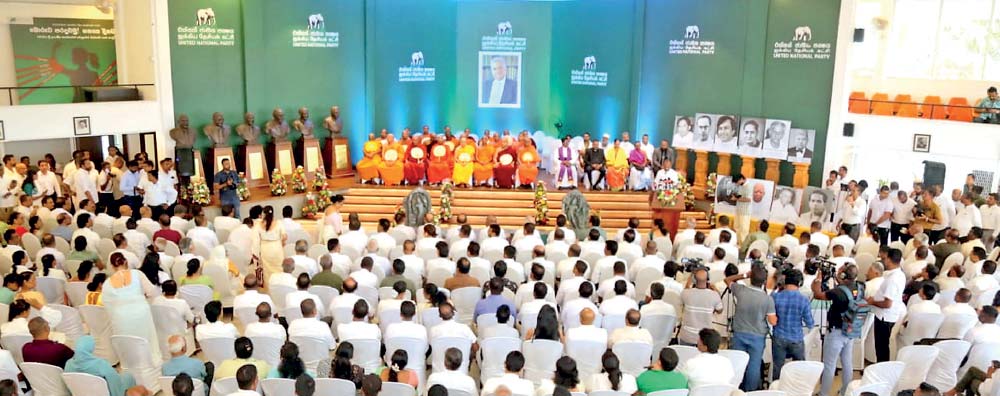
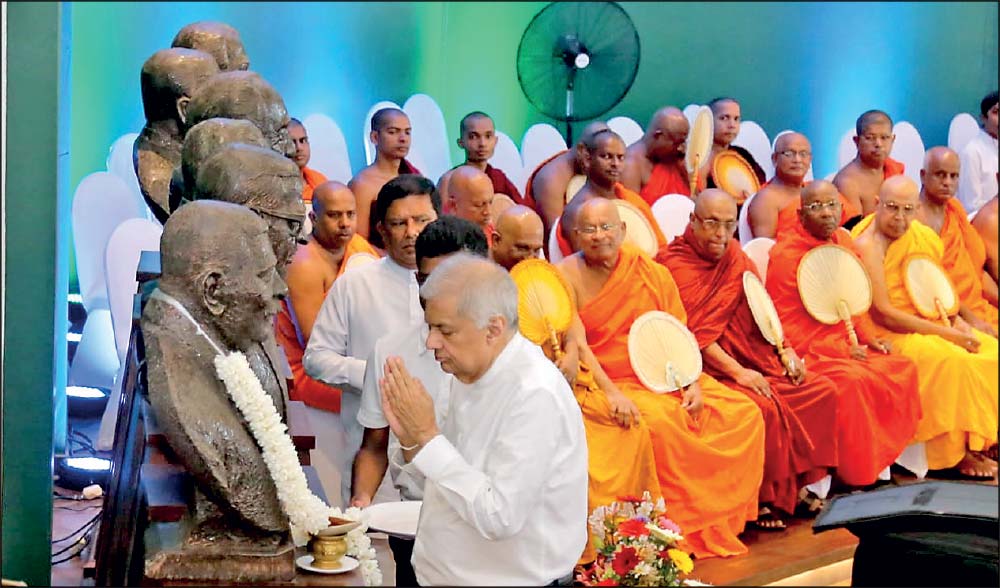
The United National Party (UNP), one of Sri Lanka's oldest political movements, marked its 80th anniversary yesterday (6), with its leadership and representatives of several Opposition parties reflecting on the party’s political legacy, whilst warning of challenges to democracy and the country’s constitutional order.
Addressing the anniversary event, former President and UNP leader Ranil Wickremesinghe said the party, founded on 6 September 1946 under the leadership of D. S. Senanayake should use its 80th anniversary to begin shaping a modern political organisation capable of addressing the needs of the 21st century.
He outlined plans for a "modern UNP" to be unveiled in December, timed to the 120th birth anniversary of former President J.R. Jayewardene.
“The modern UNP will emerge at that time. I hope to shape the ideologies of the modern UNP according to the ideas it has today, add new faces, and create a Sri Lanka that is fit for the 21st century,” he said.
Wickremesinghe noted that several of the party’s founding members were no longer alive, but their political legacy continued through their children and grandchildren, including within other political parties.
“One of the founding members was D. A. Rajapaksa. Two of his sons served as Presidents of this country,” he said.
Wickremesinghe said the theme of the anniversary program was “Sovereignty”, tracing its development from independence in 1948 through the republican constitutions of 1972 and 1978.
He argued that the 1978 Constitution had established the principle that sovereignty belongs to the people and could not be alienated, with legislature, the executive and the judiciary exercising that sovereignty through the constitutional framework.
Wickremesinghe said the protection of that principle had become particularly important amid what he described as restrictions on political parties, arrests of politicians and pressure on trade unions and professional groups.
“The biggest threat to this system is the non-recognition of the sovereignty of the people,” he claimed.
He also criticised attempts to weaken independent institutions, alleging that the Government was targeting the Bar Association, doctors, and the Buddhist clergy.
"Where is this country governed? From Parliament or from Pelawatte?" Wickremesinghe asked, charging all of this is destroying the country’s constitution and the sovereignty of the people.
He called for political forces to come together to protect the constitutional principle of popular sovereignty.
He also condemned the arrest of Sri Lanka Podujana Peramuna (SLPP) National Organiser and MP Namal Rajapaksa, grandson of founding member D.A. Rajapaksa, whom he had personally invited to the celebration.
“Unfortunately, Namal Rajapaksa was arrested,” Wickremesinghe said, adding that he and the UNP strongly opposed the action.
People’s United Opposition convener Prof. G. L. Peiris said sovereignty was key to Sri Lanka’s democratic system, arguing that fundamental changes to the Constitution should be subject to the direct approval of the people.
He recalled that the country’s sovereignty had been held by foreign powers for centuries before independence in 1948, and said the constitutional development that followed ultimately placed sovereignty directly with the people.
Peiris said the 1972 Constitution transferred sovereignty to the Council of State, while the 1978 Constitution went further by vesting sovereignty directly in the people rather than their representatives.
“Under the current constitution, sovereignty is very clearly vested in the people. It is practically exercised through a referendum,” he said.
While Parliament has the power to make laws, Prof. Peiris said that power was not absolute, where fundamental constitutional principles were concerned.
“In matters that are of utmost importance to the people, in changing the basic features of the Constitution, the opinion of the people should be obtained directly, not through members of Parliament,” he said.
He stressed the importance of judicial independence, arguing that any fundamental change affecting it should also require a referendum.
“If a government wrongly usurps the sovereignty of the people, a future government inevitably has a responsibility to correct that situation and return the sovereignty that was taken away to the people,” Prof. Peiris said.
Sri Lanka Freedom Party (SLFP) Chairman Nimal Siripala de Silva offered cross-party tribute, crediting the UNP's historical contributions from D.S. Senanayake's agricultural colonisation schemes to Ranasinghe Premadasa's garment factories and Gam Udawa housing program, to J.R. Jayewardene's open economy.
He highlighted D. S. Senanayake’s agricultural development program, including the establishment of farming colonies in previously underdeveloped areas, as well as the economic and social programs introduced by successive UNP governments.
He credited late President Ranasinghe Premadasa with establishing around 300 garment factories and promoting export-oriented employment, while also highlighting the Gam Udawa program.
de Silva said J. R. Jayewardene’s introduction of the open economy had taken the country in a new direction, noting that successive governments had subsequently adopted policies aimed at strengthening the private sector.
He singled out Wickremesinghe's economic stewardship in 2022, at a time when the country was facing severe shortages of foreign exchange and essential commodities.
“When the country was bankrupt and ran out of dollars, when the people were unable to get gas and oil and when everyone rejected him, he took over the leadership of this country. Wickremesinghe, without thinking about his political journey,” de Silva said.
He acknowledged that Wickremesinghe made many difficult decisions to stabilise the economy before handing over the country to the present administration with $ 6 billion in the Government coffers.
de Silva also recalled that the SLFP itself had emerged from the UNP, noting that S. W. R. D. Bandaranaike had left the UNP to pursue what he regarded as a more progressive political path.
While acknowledging ideological differences, he called for politics to remain centred on competing ideas rather than hostility. "Politics is not hate politics, but democracy is only ideological politics."
Samagi Jana Balawegaya (SJB) General Secretary Ranjith Madduma Bandara delivered the historically detailed remarks, recounting the UNP's founding at Colombo's Farm Court House in 1946, where D.S. Senanayake declared it "a party that belongs to all races."
He listed the party's achievements; the Gal Oya, Minipe and Mahaweli irrigation projects, free trade zones, and the extension of free education.
Bandara said the UNP had to face the 1971 rebellion against democracy, the JVP 1988-1989 conflict, and the 30 years' civil conflict to protect the country's freedom and democracy, referring to the deaths of leaders including; Ranasinghe Premadasa, Gamini Dissanayake and Lalith Athulathmudali, as well as thousands of party members.
“The party had lost leaders, and six to seven thousand party members also sacrificed their lives,” he added.
He said the country was again facing a challenge to democratic institutions, arguing that the balance among the legislature, executive and judiciary had weakened.
“The 22nd Amendment is working to destroy the independence of the judiciary and the country’s democracy,” Bandara claimed.
Noting that the UNP and SJB, both descended from the same political lineage, he said political forces should set aside differences in the interests of protecting democracy.
“Many of the policies of the UNP are the same as our policies. I also started politics with the UNP and today I am working for the SJB. At this important time, the UNP and the SJB should unite again,” Bandara said.



